When to Hire a Technical Writer, When to Automate, and How They Work Together
Decide whether your documentation problem needs a technical writer, automation around an existing owner, or both.
- Written by
- Puneet Arora (opens in a new tab)
- Published on
- Read time
- 11 min

Decide whether your documentation problem needs a technical writer, automation around an existing owner, or both.
TL;DR
- Hire a technical writer when nobody owns the documentation program or when the work requires audience judgment, information architecture, stakeholder alignment, and editorial accountability.
- Automate when a writer or another docs owner is buried in change detection, context gathering, routine drafting, repetitive checks, and follow-up.
- If the company lacks ownership and the current workflow cannot keep pace, solve both problems together: give a technical writer clear authority and add an agent around the repeatable steps.
- Socure used this model across 25+ products. Peter Schwarck reviewed and published the updates while EkLine prepared source-grounded drafts, giving him more time for information architecture and larger documentation improvements.
How Socure paired a technical writer with automation
Socure had one technical writer supporting more than 25 products across two platforms. Documentation requests reached him through chat messages, tickets, and a release tracker. Identifying affected documentation consumed time before he could assess the change, resolve open questions, and shape the update.
Socure already had a technical writer with clear ownership. Its bottleneck was detecting affected documentation and preparing updates across a large product surface, so the company added EkLine around Peter Schwarck's workflow. EkLine surfaced likely documentation work and prepared source-grounded drafts. Peter decided what needed to change and approved publication.
Peter also gained time for information architecture and larger documentation improvements that had been waiting for attention.
In seven weeks, Socure reported 348 merged documentation updates, the estimated equivalent of more than 1,000 hours of documentation work, with no added headcount. This establishes Socure's result only; staffing requirements vary by company. It shows how a writer-led workflow can increase coverage when automation handles defined preparation steps.
Read the full Socure case study.
Diagnose the documentation work before setting headcount
A request for a technical writer often bundles several different problems:
- Nobody is accountable for the documentation.
- The product changes faster than the current owner can track.
- Engineers know the product but cannot keep writing every guide.
- Existing docs lack structure, consistency, or a clear audience.
- Support answers useful questions that never become public documentation.
- Routine maintenance consumes the time needed for strategic work.
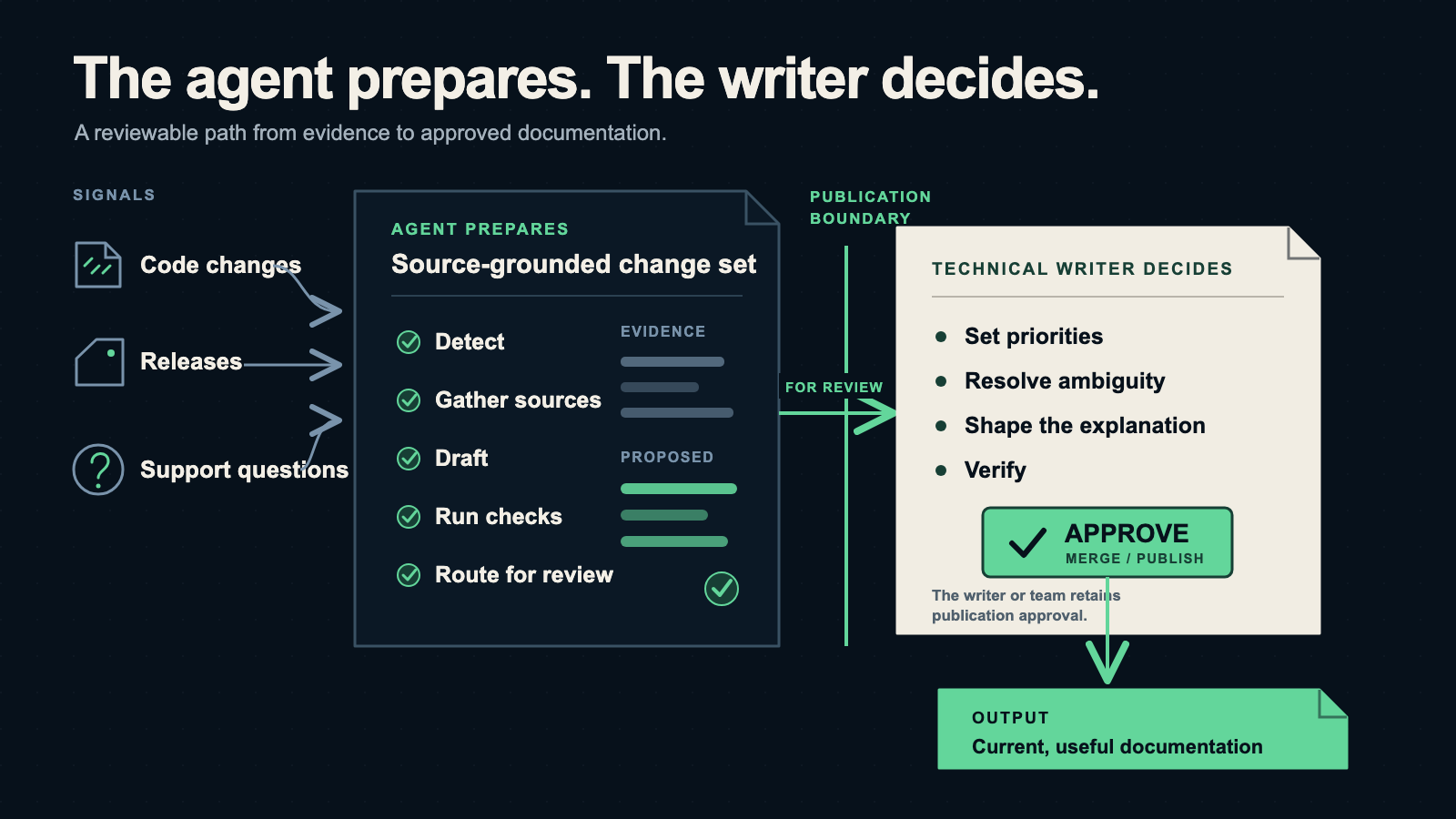
Different items require different responses. Missing ownership calls for a hire or an explicit assignment. Repeatable workflow gaps call for automation around that owner.
Before opening a requisition, list the documentation work from the last month. For each item, mark where audience judgment, source validation, structure, or approval was required, then mark which steps followed a repeatable pattern. Most documentation work contains both. This map will show whether the immediate gap is ownership, capacity, or both.
| Type of work | Examples | Best owner |
|---|---|---|
| Judgment | deciding what the audience needs, resolving conflicting sources, choosing the right explanation | technical writer |
| Program ownership | information architecture, editorial standards, roadmap, stakeholder alignment | technical writer |
| Subject-matter validation | confirming API behavior, security details, and product intent | engineer or product owner, coordinated by the writer |
| Detection | finding which pages are affected by a code change, release, or recurring support question | automation |
| Preparation | gathering source context and drafting a routine update | automation, reviewed by the writer |
| Repeatable review | checking terminology, style rules, links, structure, and required sections | automation, governed by the writer |
If no one owns the documentation program, hire or assign that owner first. If an owner exists but cannot keep pace with product change, add automation around their workflow. Teams facing both problems should do both.
 (opens the full-size image in a new tab)
When to hire a technical writer
Open the requisition when the missing capability is human judgment or clear ownership.
Nobody owns the user's learning experience
Documentation is a product surface. Someone has to understand what a developer is trying to accomplish, where the current explanation fails, and how the pieces should fit together. A queue of generated pages does not provide that ownership.
A technical writer can turn scattered requests into a coherent program. They define the audience, establish the structure, set standards, and decide what deserves attention first.
The documentation needs information architecture
A growing product accumulates pages, examples, release notes, and troubleshooting articles. The hard work is deciding how users should move through them.
Automation can identify duplicated or disconnected content. A writer decides whether to merge pages, split a long guide, change the navigation, introduce a new concept, or remove material that no longer helps.
Product teams disagree about the correct explanation
Code, tickets, internal discussions, and support answers do not always agree. Someone must resolve the conflict and produce an explanation the company is willing to stand behind.
This is editorial and organizational work. It often requires interviewing engineers, product managers, support, security, and customers. Hire for it.
The company needs an accountable editorial standard
Terminology, tone, examples, accessibility, and risk boundaries need an owner. Automation can apply rules after the rules exist. A writer creates those rules, updates them when the product changes, and knows when an exception is justified.
High-risk content requires careful judgment
Authentication, billing, permissions, migrations, security, and breaking API changes deserve a named owner. An agent can gather evidence and prepare a draft. A writer should coordinate the review and make sure the final guidance is clear, complete, and approved.
When to automate documentation work
Automation makes sense when the company already has a qualified documentation owner, but repeatable workflow steps with stable inputs and review rules consume too much of that person's time.
The writer has to chase every product change
A writer cannot attend every engineering discussion or inspect every merged pull request. When the documentation process depends on someone remembering to file a ticket, important changes will arrive late or remain invisible.
Automation can monitor defined product signals, identify likely documentation impact, and bring the change to the writer. The writer then decides whether an update is needed.
Routine updates begin with the same research every time
Many documentation tasks start with gathering a code diff, release context, an existing page, a support conversation, and the current style rules. An agent can assemble that context and prepare a reviewable first draft.
The writer starts with relevant sources and a draft to assess, then decides whether the update is useful, accurate, and ready for broader review.
Reviewers repeat the same checks
Style, terminology, links, headings, required sections, and structural rules can be checked consistently before a human review. The writer should define the rules and own exceptions. The agent should run the routine inspection every time.
Documentation requests arrive faster than they can be triaged
A crowded queue hides the difference between a small factual correction and a new guide that needs research. Automation can classify and route the work so the writer spends attention according to risk and user impact.
The docs owner has no time for strategic improvements
When maintenance and change-chasing fill the week, the writer has less time for onboarding research, information architecture, and other program-level improvements. Automating defined preparation and checking steps restores that capacity without removing editorial ownership.
How the writer and the agent should work together
The writer defines and owns the documentation system, including its priorities, standards, and approval rules. The agent works within those boundaries.
A practical workflow looks like this:
- A code change, release, repeated support question, or documentation audit creates a signal.
- The agent gathers the relevant sources and identifies the affected documentation.
- The agent prepares a draft or a focused recommendation with its source trail.
- The writer checks audience fit, product accuracy, structure, terminology, and risk.
- An engineer or product owner resolves any open technical question.
- The writer approves, edits, rejects, or redirects the work.
- The team measures whether the update reduced drift, repeated questions, or reviewer effort.
This model keeps publication authority with the team. It also creates a visible path from product change to documentation change, which is difficult to maintain through ad hoc tickets alone.
Technical writers evaluating what this changes in their daily work can read how EkLine's Docs Agent works. The writer retains program and editorial ownership: deciding what users need, shaping the information architecture, resolving ambiguity, coordinating technical review, and approving publication. The agent expands coverage by preparing traceable work for review.
A decision guide for the requisition you are about to open
Use the following questions before deciding what to buy or whom to hire.
| Question | If the answer is yes | Recommended action |
|---|---|---|
| Is there no accountable documentation owner? | Strategy and judgment are missing. | Hire a technical writer. |
| Are engineers writing most customer-facing docs from scratch? | The company needs editorial ownership and a better contribution workflow. | Hire a writer and automate source gathering plus first drafts. |
| Does a capable writer spend most of the week chasing updates and doing routine maintenance? | Capacity is trapped in repeatable work. | Add automation around the writer. |
| Are the docs poorly structured or hard to navigate? | The problem requires information architecture. | Hire or assign a senior documentation owner before automating broadly. |
| Are updates late because teams forget to notify docs? | Change detection is broken. | Automate detection and routing. |
| Is there nobody qualified to review generated updates? | The approval layer is missing. | Establish ownership before adding generation. |
| Is the product surface growing across many teams? | Ownership and coverage must scale together. | Use a writer-led, agent-assisted model. |
Open the requisition when the company needs an accountable documentation owner. If maintenance volume is also a problem, define the writer's remit and automate the repeatable parts of the workflow as part of the same plan.
What to take from the Socure example
Socure's result shows one condition where this model can work: a capable writer already owns the program, while change detection and draft preparation limit coverage across a broad product surface.
Treat the 25+ product ratio as specific to Socure. Product complexity, release cadence, existing documentation quality, review requirements, and source access will change the staffing and workflow a different company needs.
Peter remained responsible for editorial judgment and publication. The workflow gave him more time for information architecture and documentation improvements that had been crowded out by incoming requests.
Documentation automation should increase the writer's control over the program and capacity to improve it.
Run a small workflow test before changing the team plan
Test the workflow on recent documentation work rather than a generic automation demo.
- Select five to ten recent product changes and recurring support questions that led to documentation work.
- Ask the current docs owner to mark where each item required audience judgment, source validation, drafting, or approval, and which steps repeated across items.
- Keep audience decisions, ambiguity resolution, structure, and approval with the writer.
- Test automation on detection, context gathering, first-draft preparation, and repeatable checks.
- Record the affected pages found, factual corrections made during review, reviewer time, and elapsed time from signal to approved change. Compare those results with the current process.
The result should tell you what the requisition needs to accomplish. If the test reveals both missing ownership and a repeatable maintenance bottleneck, hire the writer and automate the bottleneck. If only one is missing, solve that problem first.
Make the requisition match the bottleneck
Open the requisition if the team lacks an accountable documentation owner with authority to set priorities, structure, and standards. Add automation if that owner is spending too much time finding changes, collecting source context, preparing routine updates, or running repeatable checks. If both conditions are true, fund the role and the workflow together.
Keep publication approval with the writer. Evaluate the combined system by documentation coverage, factual corrections during review, reviewer effort, and user outcomes.
To see how this workflow would handle your recent product changes and support questions, book an EkLine walkthrough.
FAQ
Hire a technical writer when the company lacks clear documentation ownership, audience judgment, information architecture, or editorial governance. Automate when an existing owner spends too much time detecting changes, gathering context, drafting routine updates, and checking repeatable rules. Fast-moving technical companies often need both: a writer who owns the documentation program and an agent that handles repeatable work.
No. EkLine gives technical writers leverage. It helps detect documentation work, gather source material, draft updates, run quality checks, and route changes for review. The writer still decides what users need, resolves ambiguity, shapes the information architecture, and approves publication.
A technical writer should own audience understanding, documentation strategy, information architecture, editorial standards, cross-functional decisions, high-risk explanations, and final approval. These jobs depend on audience judgment, cross-functional trust, and clear accountability.
Good candidates include detecting documentation impact from product changes, collecting relevant source context, drafting routine updates, checking style and terminology, finding broken links, and routing a reviewable change to the right owner.
Socure paired one technical writer with EkLine across more than 25 products. Peter Schwarck reviewed and published the updates while EkLine detected changes and prepared source-grounded drafts. Socure reported 348 merged documentation updates in seven weeks, the estimated equivalent of more than 1,000 hours of documentation work.